SOCIB CAIB Micinn

modelling and forecasting facility


We provide in this section the SOCIB Balearic RIssaga Forecasting System (BRIFS) results. Meteotsunamis are oceanic waves that possess tsunami‐like characteristics but are meteorological in origin.They occur in oceans all over the world, usually under their local names such as “Rissaga” [Ramis and Jansá, 1983; Tintoré et al., 1988; Gomis et al., 1993] in Ciutadella harbor (Menorca Island, Spain). The sea level oscillation during a Rissaga event corresponds to the oceanic response to some atmospheric gravity waves [Ramis and Jansá, 1983; Monserrat et al., 1991a] and/or to convective pressure jumps [Jansá, 1986; Monserrat et al., 2006]. In the western Mediterranean, travelling atmospheric pressure oscillations generate these long oceanic surface waves that can become amplified and produce strong seiche oscillations inside harbors.

You will find bellow, the system configuration as well as the daily historical (summer 2011 and spring and summer 2012) and today forecast of both Mean Sea Level Pressure (MSLP) and Sea Level Anomalies (SLA). The 2006 extreme event is then studied and the 2011 Rissaga events forecasts are compared to available MSLP and SLA observations.

BRIFS Menu

DISCLAIMER: The experimental products presented here are provided "as is" without warranty of any kind, including any implied warranties of merchantability or fitness for a particular purpose. The objective of this forecast is to try to complement the actual AEMET Rissaga alert system.

BRIFS configuration


The Weather Research and Forecasting (WRF) model (v3.2, Skamarock et al., 2008) has been implemented following the configuration described in Renault et al. (2011) in a 2 nested grid configuration. The largest domain approximately covers the western Mediterranean basin with a horizontal resolution of 20 km while the inner domain covers the area that corresponds to the eastern part from Africa to the Balearic Islands, with a horizontal resolution of 4 km (see figure 1a). The coarser grid reproduces the large-scale synoptic features that force the local dynamics in the second grid at each time step. The simulations are performed using a two-way nesting technique, starting at 0000 UTC, 13 June 2006 and lasting 72 h. Ninety-seven vertical levels are employed, more closely distributed in the lower levels to adequately resolve the characteristic inversion layer associated with Rissaga phenomena (Ramis and Jansá, 1983, Jansá, 1986). Initial state and boundary conditions every six hours are prescribed from the synoptic atmospheric conditions as obtained from the NCEP FNL/GFS analysis/forecast (http://dss.ucar.edu/datasets/ds083.2). The FNL analysis and GFS forecast have respectively a spatial resolution by 1ºx1º and by 0.5ºx0.5º.

Figure 1: BRIFS domain configuration


The oceanic simulations were performed with the Rutgers version of the Regional Ocean Modeling System (ROMS, www.myroms.org). ROMS is a 3D free-surface, split-explicit primitive equation model with Boussinesq and hydrostatic approximation. The reader is referred to the work of Shchepetkin and McWilliams (2005) for a description of the numerical algorithms. Two embedded domains were implemented (refer to figure 1b and 1c). The parent domain covers the Balearic Islands with a horizontal resolution of 1km (256x200 grid points). Bottom topography is derived from the Smith and Sandwell product (Smith W. H. F., and D. T. Sandwell, 1997). The higher resolution nested domain covers the Western part of Menorca with a resolution of 10m (401x302 grid points), allowing a good sampling of the Ciutadella harbor coastline. The bathymetry was derived from a high-resolution bathymetry provided by the University of Cantabria. The boundary and initial conditions of the parent domain are prescribed analytically , and include vertically homogeneous temperature and salinity such that the configuration is almost 2-dimensional; the absence of density stratification eliminates baroclinic pressure gradients but the velocity can still be vertically sheared consistent with the quadratic drag parameterization of bottom drag. The embedded domain boundary conditions are derived from the parent model using integrated current and sea surface elevation. The model is forced every 2 minutes by the WRF Sea Level Pressure (SLP). A more complex configuration using WRF surface wind forcing in addition to SLP was also run to test the wind impact on the ocean response.

Figure 2: Scheme of the Forecasting system


MSLP Best Guess estimation

The initial and boundary conditions have a spatial resolution by 1ºx1º (when analysis is used) and by 0.5ºx0.5º (GFS forecast). It can induce some spatial lag in the simulated atmospheric disturbance location. Therefore, to correct some of these lags, a spatial correction is applied on the MSLP fields location. This method is applied on a two-day forecast characterized by an output frequency of 2 minutes.
First, the MSLP first order derivative is estimated in order to capture the high frequency change. Then, an Empirical Orthogonal Function (EOF) analysis is applied on these derivative fields MSLP fields over the box (2.6E 4.6E 39.2N 40.2N, see Figure 3). If an atmospheric disturbance is present, it will correspond to the first EOF mode since it will capture the main 2mn variability. A polynomial of the first order is estimated using the minimum and maximum of the spatial component (see green line on Figure 3). The obtained line is therefore translated over the Minorca channel (dashed green line on Figure 3) and a latitudinal correction is computed as the difference between the coefficient of the first line and the second line one. This latidunal correction is therefore added on the MSLP latitude translating northward or southward the MSLP disturbance and allowing it travelling over the Minorca channel (see Figure 3). In the following forecast, both solutions (without correction and "best fit" correction) are given).

Figure 3: The WRF best guess estimation. A) Non-corrected Mean Sea Level Pressure at 22/07/2011,12:46. b) Non corrected first EOF mode applied on the first MSLP derivative. The green full and green dashed lines represent respectively the propagation direction of the atmospheric disturbance and the best guess propagation direction. c) Best guess First EOF mode. d) Best Gueess Mean Sea Level Pressure at the same time than (a)

BRIFS Forecasts

Choose a Rissaga forecast date on the calendar, please.

Videos are only displayed in Google Chrome, Mozilla Firefox and Opera.


The following videos represent the Mean Sea Level Pressure (MSLP) forecast each 2 minuts.
Note a Rissaga can occur if an atmospheric pressure disturbance travels over the Minorca channel (e.g., 2006 case)
Selected day: Selected day + 1
Download video Download video


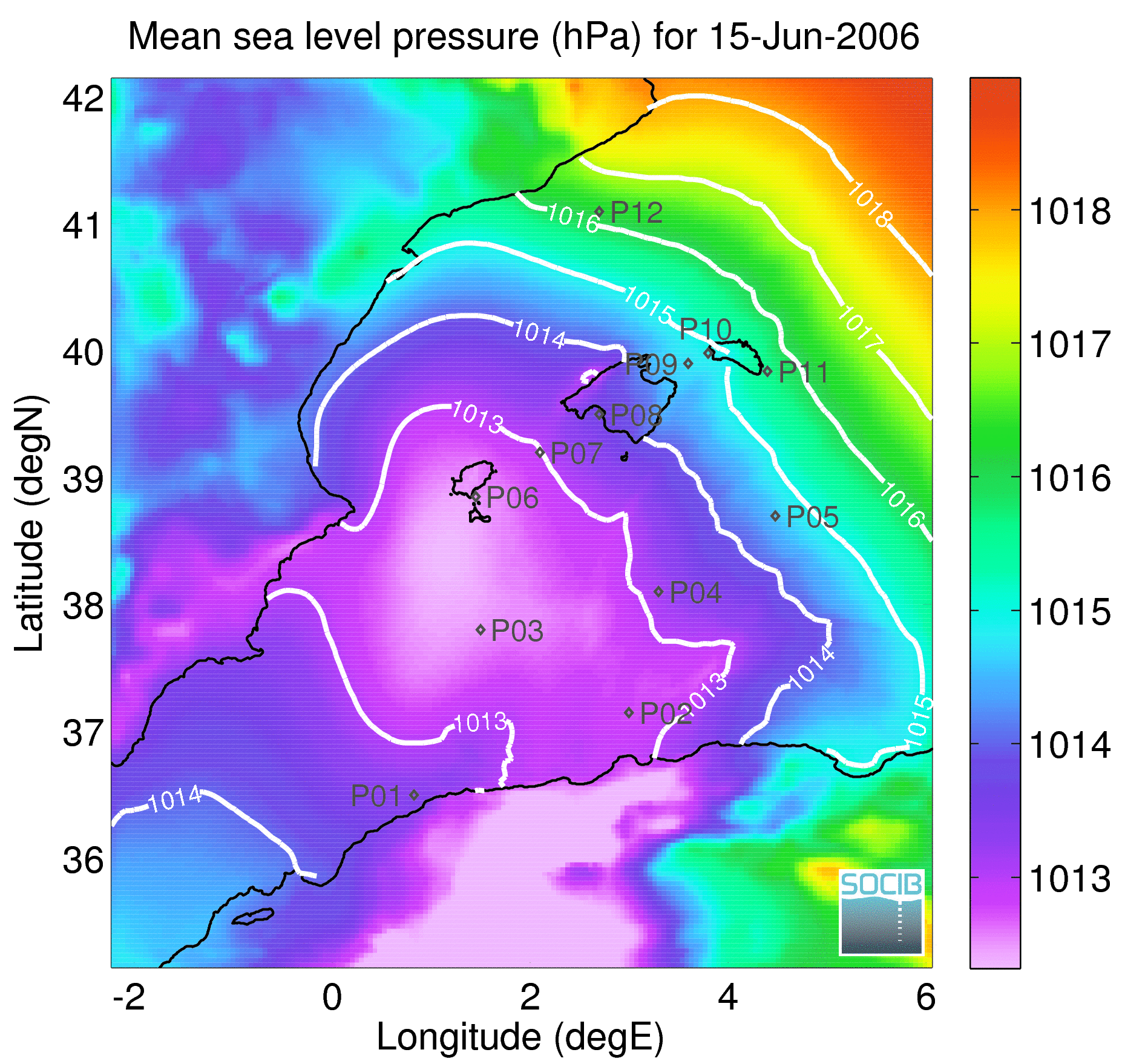
In order to detect the presence or not of atmospheric pressure disturbance close to the Balearics Islands, some Mean Sea Level Pressure (MSLP) timeseries at different control points (see Figure 1,2 and 3) are extracted from the BRIFS forecast. The atmospheric pressure disturbances that can induce a Rissaga are characterized by sharp MSLP jump and/or MSLP oscillations.


Figure 1: Today mean Mean Sea Level Pressure and locations of the control points.
Selected day: Selected day + 1

Figure 2: Forecasted Mean Sea Level Pressure evolution at P1, P2, P3, P4, P5 and P6

Figure 3: Forecasted Mean Sea Level Pressure evolution at P1, P2, P3, P4, P5 and P6
View original image View original image


The oceanic response in term of Sea Level Anomalies is illustrated in Figure 4 at Palma de Mallorca, Middle of Channel, Entrance of Ciutadella harbor and inside the Ciutadella harbor.
These different locations allow monitoring the oceanic response and the presence or not of oceanic response resonances (via Proudman, coastal shelf amplification a nd harbor resonance) and Rissaga (e.g. Renault et al., 2011, refer to reference section). The figure 5 is similar than Figure 4 but provides the oceanic response as simulated using the "best fit" correction (see configuration).


Figure 4: 2-days Sea Level Anomalies forecast.

Figure 5: 2-days Sea Level Anomalies forecast using the "best fit" correction.

Historical visualization

In this section, user can use the following application in order to display the 1-day and 2-days forecasts Mean Sea Level Pressure and Sea Level Anomalies (accumulated along the forecast season) at Palma de Mallorca, Entrance of Ciutadella and inside the harbour of Ciutadella. Additionally, observations at the same location will be soon available online.

Jweb application

The 2006 Extreme case

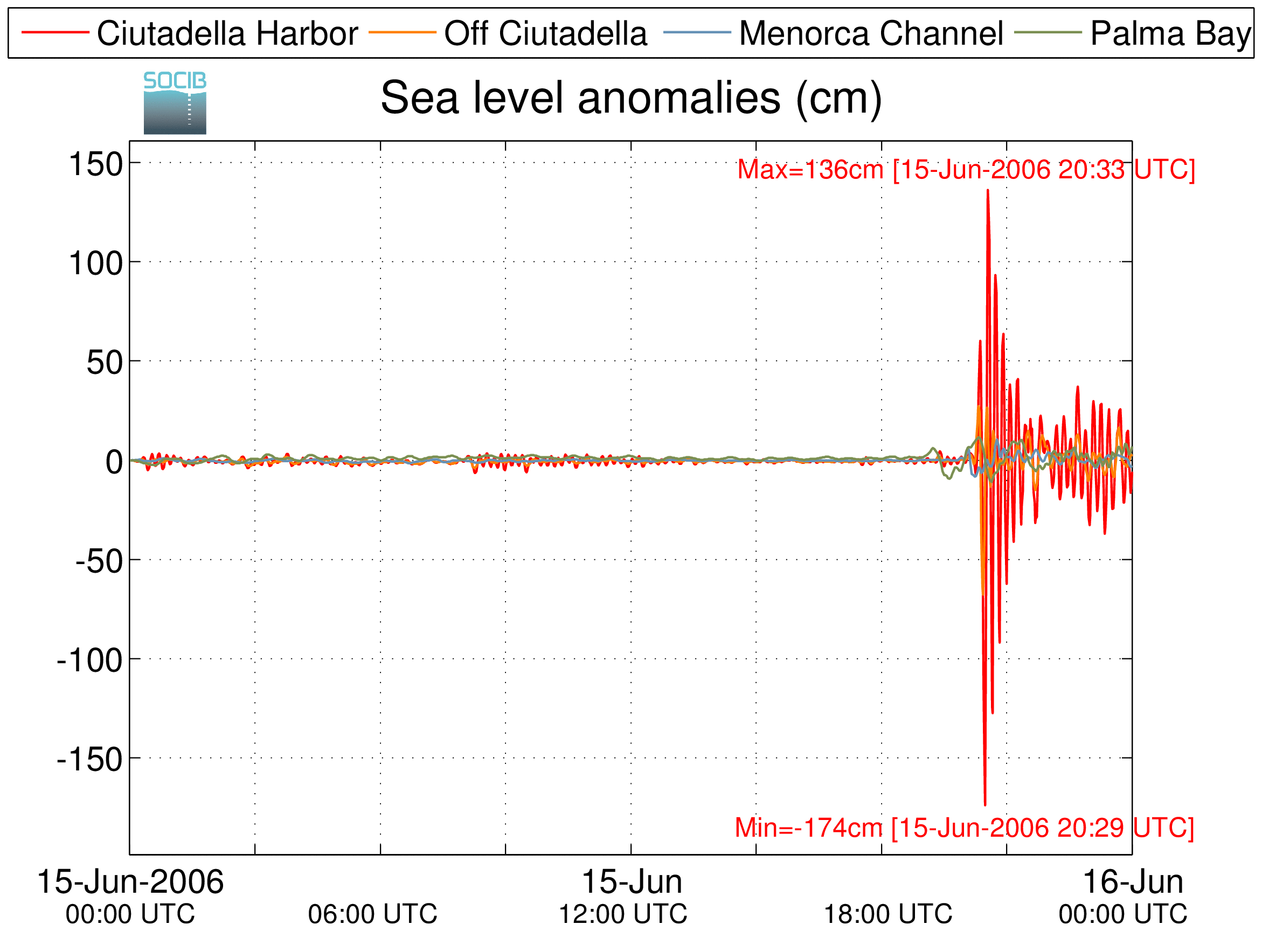
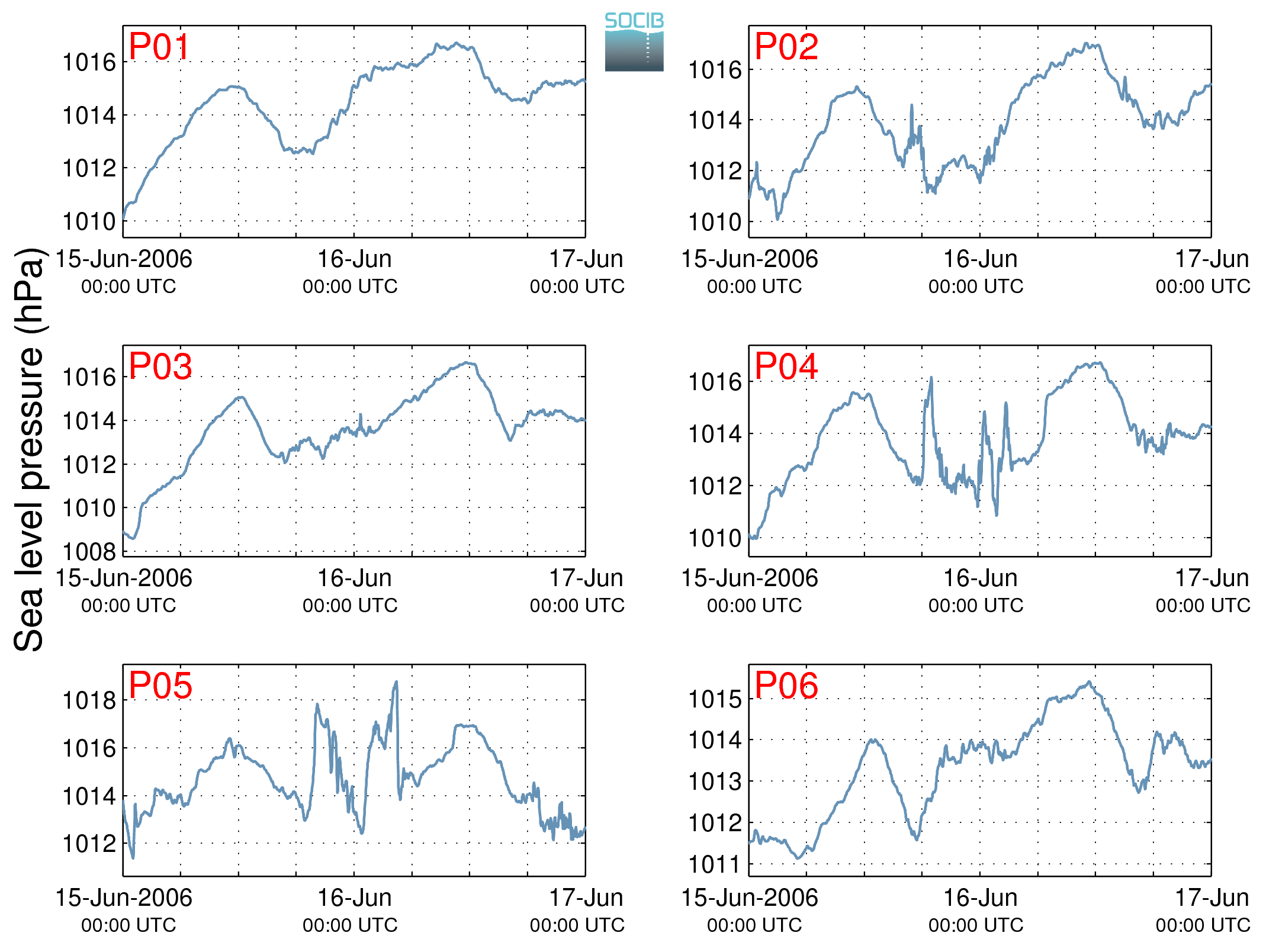
In this section, the June 2006 meteotsunami event in Ciutadella harbor (Menorca Island, Spain) is presented. The reader is invited to refer to Renault et al. (2011, here) for further details of this study. This meteotsunami has been studied numerically during its full life cycle, from the early atmospheric stages to the atmosphere‐ocean resonant phase and the final highly amplified harbor oscillation. The Weather Research Forecast (WRF) atmospheric model adequately reproduces the development of a convective nucleus and also reproduces the induced atmospheric pressure oscillations moving at a speed of 27 m/s. The oceanic response is studied using the Regional Ocean Modeling System (ROMS), forced by the WRF pressure field. It shows an inverse barometer wave front in the open ocean progressively amplified through resonant interactions in the different shelf and coastal regions. Please find bellow a video (Video 1) of the Mean Sea Level Pressure evolution each 2 minuts as well as some MSLP timeseries (Figure 1) at different locations and the associated oceanic response (Figure 2) in term of Sea Level Anomalies.


Video 1: Rissaga 2006 event


Figure 1: SLP time series


Figure 2: Sea Level Anomalies at different locations

The 2011 cases

The predictive capability of the new WRF/ROMS SOCIB Meteotsunamis forecasting system has been tested during summer of 2011. The forecasting system started from July 2011. Five Meteotsunamis events (not extreme) occurred from the forecasting system start. Preliminary results show that the forecast was able to reproduce in relatively good agreement both atmospheric pressure oscillations (wave train or pressure jump) and oceanic response into the Ciutadella harbor (see table 1) for 4 of the 5 events.


Table 1: Mean Sea Level Pressure and Sea Level Anomalies at Ciutdella as observed and simulated by the BRIFS system